Keeping a Symptom Log That Is Actually Worth Reading Back: Tracking Gut Health Supplement Benefits
Quick Answer: What Makes a Symptom Log Useful?
A useful log is short enough that you still fill it in during week six, and structured enough that you can compare week six against week one. Score five things a day — dose taken, bloating one to five, bowel movement, appetite one to five, and one line of context — and log for two weeks before you start anything so you have a baseline to compare against. Then read it back by the week, never by the day, because daily readings are mostly noise.
- Two weeks of baseline first, or you have nothing to compare with.
- Five fields, thirty seconds. Longer logs get abandoned, and an abandoned log tells you nothing.
- Read weekly averages, not individual days.

Why memory is the wrong instrument
Ask someone eight weeks into a supplement whether it helped and you will get a confident answer built out of almost nothing. Human recall of low-grade, fluctuating symptoms is poor in a specific and predictable way: we remember the peaks, we remember the most recent week, and we quietly reshape the earlier weeks to fit whatever conclusion we have already reached. Someone who has decided a product works remembers week one as worse than it was. Someone who has decided it does not remembers it as better.
This matters more here than in most contexts, because the changes on offer are genuinely small and slow. A prebiotic fibre acting on satiety signalling does not produce a moment you can point at. It produces a modest shift in how hungry you are at four in the afternoon, spread over weeks, mixed in with sleep, stress, season, work pattern and whatever you ate the night before. That is precisely the kind of signal memory cannot recover and a boring daily record can.
There is a second reason, and it is the practical one. A log makes the decision to stop easier. Without one, quitting feels like admitting you wasted money, so people carry on out of sunk cost. With eight weeks of flat numbers in front of you, stopping is just reading a result.
The five things worth logging, and the many that are not
The most common failure is an over-designed log. A fourteen-field spreadsheet gets filled in beautifully for four days and then abandoned, which is worse than useless because the four days look like data. Restrict yourself to five fields.
- Dose taken. A simple yes or no, plus the time. This is the field people think is trivial and it is the most important one in the log — it is the only thing that tells you whether you tested the product at all.
- Bloating, 1–5. One is a flat, comfortable stomach, five is visibly distended and uncomfortable. Score it at the same time each day, ideally late afternoon when it tends to peak.
- Bowel movement. Whether there was one, and a rough consistency note. Two words is enough.
- Appetite, 1–5. How hungry you were between meals, not how much you ate. One is barely thought about food, five is preoccupied by it.
- Context, one line. Travel, illness, a late night, a big meal out, a new medication. This field is what stops you misreading a bad week as a product failure when it was a stomach bug.
Things to leave out: anything you cannot measure consistently, anything that requires a device you will not always have, mood scores that turn into a diary, and precise food weights. Detailed food logging is a legitimate tool for a different job, but bolted onto a supplement log it doubles the effort and halves the completion rate.
Gut health supplement benefits: what a useful score actually looks like
The plausible gut health supplement benefits are not dramatic and they do not all appear on the same timeline, which is why a single overall "did it help" score is useless. Different outcomes need different instruments and different patience.
| What to track | How to score it | How often | When a change would plausibly appear |
|---|---|---|---|
| Bloating and distension | 1–5, same time each day | Daily | Often worse in week 1–2, then settling by week 3–4 |
| Bowel regularity | Movement yes/no, brief consistency note | Daily | Within 1–2 weeks, and among the more reliable signals |
| Between-meal hunger | 1–5, scored mid-afternoon | Daily | Weeks 2–6, gradually, if at all |
| Waistband fit | Loose / same / tight on one specific garment | Weekly | Weeks 6–12 |
| Body weight | Weekly average of daily weigh-ins | Read weekly only | Weeks 8–12, and heavily dependent on diet |
| Energy and sleep | 1–5, optional | Daily if useful | No strong expectation; useful mainly as context |
The right-hand column is doing important work. If you expect a waistband change in week two you will conclude the product failed before it has had a chance to do anything; if you are still waiting patiently at week twenty, you are ignoring a result. Writing the expected timeline down at the start, before you have any feelings about the outcome, is one of the cheapest safeguards available.
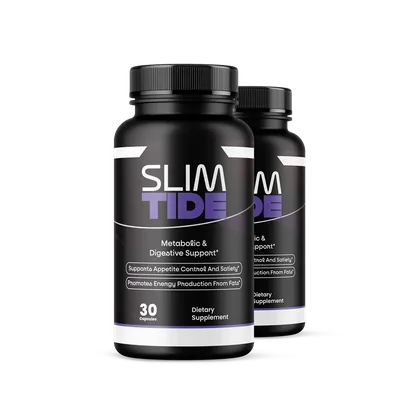
Planning an eight-week trial of your own?
A log only works if the supply lasts the whole window. SlimTide is a once-daily stimulant-free capsule, and if you are weighing up the best gut health supplement options for a proper eight to twelve week run, the official store carries the full label and current pricing.
See the official storeGetting the baseline right
Almost everyone skips this, and skipping it is the single biggest reason logs turn out unreadable. Start the log two weeks before you start the supplement. Score exactly the same fields in exactly the same way, with nothing new introduced.
The baseline does two things. It gives you a number to compare against instead of a memory. And it shows you how much your own symptoms move on their own, which is usually far more than people expect — a bloating score that swings between two and four across a normal fortnight is entirely ordinary. If your baseline swings that much, then a post-supplement week averaging 2.8 against a baseline of 3.0 is not a finding. It is your normal variation.
That single insight is worth the fortnight on its own. It is the difference between a log that answers a question and a log that manufactures a false answer.

Reading it back without fooling yourself
Reading a log is a skill, and it has three rules.
Average by week, never read a day. Individual days are dominated by what you ate, whether you slept and where you were. Weekly averages strip most of that out.
Look at the context column before you interpret anything. A bad week that coincides with travel and a cold is not evidence about a supplement.
Check the adherence field first. If you took the dose on nineteen of twenty-eight days, you have not run a fair test, and no amount of analysis of the other columns fixes that. It is far better to restart cleanly than to draw conclusions from a half-taken course.
One more habit is worth adopting: write down, in advance, what result would make you stop. "If bloating and hunger scores are unchanged from baseline at week twelve, I stop." Committing to that before you see the numbers is what stops a log from becoming an exercise in finding reasons to continue.
A log that can only ever confirm what you already believed is not a log. Decide before you start what a negative result would look like, and write it at the top of the page.
What a personal log cannot tell you
This is where honesty is more useful than enthusiasm. A single-person log is a genuinely valuable tool for a narrow job, and hopeless at several others.
It cannot separate the product from placebo. You know you are taking something, you paid for it, and you are hoping it works. Expectancy effects on subjective symptoms such as bloating and hunger are well documented and can be substantial. Nothing in a personal log controls for that.
It cannot untangle simultaneous changes. Most people start a supplement in the same week they start eating better and walking more. The log will show improvement and will be silent about the cause. The fix is procedural, not statistical — change one thing at a time, which is set out in testing one supplement variable at a time.
It cannot generalise beyond you. Your result is one data point in one person with one microbial population, one diet and one set of circumstances. It is fully valid as a personal answer and worth nothing as evidence about anybody else.
It cannot detect anything internal. Blood markers, microbial composition, inflammation — none of that shows up in how you feel. A log records symptoms and nothing more, and no dietary supplement diagnoses, treats, cures or prevents disease regardless of what your scores do.
And a note on the evidence for self-monitoring itself: structured self-monitoring is associated with better adherence to health behaviours across a range of published research, which is a real finding but a modest one, and it is a finding about behaviour rather than about any supplement's effects.
A template you can copy in thirty seconds
Paper, notes app or spreadsheet — the medium matters far less than the fact that it is within reach at the moment you take the dose. One line per day, in this order:
Date · dose Y/N and time · bloat 1–5 · BM Y/N + note · hunger 1–5 · context
So a real line looks like: 14 Aug · Y 08:10 · bloat 3 · BM yes, normal · hunger 4 · late dinner out. That is the whole system. Keep it beside the bottle, fill it in at the same moment you take the capsule, and do a five-minute weekly average every Sunday.
Two practical additions. Photograph the page at the end of each week if you are using paper, because lost logs are the most common way a twelve-week trial ends at week five. And if you are going to take the results to a doctor or dietitian, bring the raw log rather than your summary of it — they will read the context column differently to you, and often more usefully.
If you are logging a specific formula and want to check what is actually in the serving you are scoring, the full ingredient breakdown for the product we cover is on the SlimTide page, including the fibre content that most directly drives the bloating and regularity columns.


Give the log something worth measuring
Twelve weeks is the window the mechanism needs, and the manufacturer's guarantee is what makes a window that long reasonable to commit to. If you have been comparing gut health supplement brands, the official store is the only link we carry — current pricing, full label, guarantee terms.
Order NowCommon questions
How long should I log before deciding whether a gut supplement is working?
Plan for eight to twelve weeks, with the first two weeks logged before you start anything so you have a baseline. Fibre and live culture products act on appetite signalling and the microbial population over weeks, so a two-week verdict tells you about the adaptation period rather than about the product.
What should I actually write down each day?
Five things, and no more: whether you took the dose, a bloating score from one to five, a bowel movement note, an appetite or hunger score from one to five, and one line of context such as travel, illness or an unusual meal. Anything longer gets abandoned in the second week.
Should I weigh myself every day in the log?
Weigh daily if you find it neutral to do, but only ever read the weekly average, never a single day. Day-to-day weight moves several pounds on fluid, salt and bowel contents alone, so daily readings mostly record noise. If daily weighing makes you anxious, weigh weekly or not at all and track how clothes fit instead.
Can a personal log prove a supplement worked?
No. A log with one person and no control group cannot separate the product from placebo, seasonality, or the other changes you made at the same time. What it can do well is tell you whether anything changed for you, when it changed, and whether the routine is tolerable enough to keep.
References
General information, not medical advice. These statements have not been evaluated by the Food and Drug Administration, and no dietary supplement is intended to diagnose, treat, cure or prevent any disease. Speak to a qualified healthcare professional before changing what you take.
Affiliate link. Slimtidae Health Files earns a commission on purchases made through it, at no extra cost to you. We are not the manufacturer.